
Compare detailed specifications, side-by-side differences, verified user reviews, and buying recommendations to help you make the right choice.

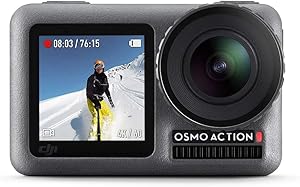
Deciding between the Sony Alpha 7 IV and the DJI Osmo Action depends on your available space, storage capacity goals, and everyday usage style:
Designed for large households, bulk grocery shoppers, and long-term storage where total cubic feet is the highest priority.
Ideal for apartments, offices, dorms, or secondary kitchen use where space efficiency and neat organization are paramount.
| Specification | Sony Alpha 7 IV | DJI Osmo Action |
|---|---|---|
| Screen/viewfinder | ||
| Diopter Adjustment | -4 to +3 | — |
| Screen Type | TFT LCD | — |
| Eye Point (mm) | 23 | — |
| Touch Screen | Yes | Yes |
| Screen Resolution Dots | 1036800 | — |
| Viewfinder Size (Inch) | 0.5 | — |
| Screen Size (Inch) | 3 | 2.25 |
| Viewfinder Resolution Dots | 3686400 | — |
| Display Type | Articulated LCD | Articulated LCD |
| Viewfinder Magnification | 0.78x | — |
| Viewfinder Coverage (%) | 100 | — |
| Viewfinder Type | Electronic | — |
| Live View | Yes | Yes |
| Photography Features | ||
| Subject / Scene Modes | No | — |
| WB Bracketing | Yes | — |
| Manual Exposure Mode | Yes | — |
| AE Bracketing | Yes | — |
| Shutter Priority | Yes | — |
| Exposure Compensation | -5 to +5 EV (1/3 EV Steps) | — |
| Aperture Priority | Yes | — |
| Self-timer | 2/5/10-Second Delay | — |
| Bulb/Time Mode | Bulb | — |
| Continuous Shooting (upto-fps) | 10 | 3,10 seconds |
| Maximum Shutter Speed (Sec) | 1/8000 | 1/8000 |
| Flash Modes | Auto, Fill Flash, Hi-Speed Sync, Off, Rear Sync, Red-Eye Reduction, Slow Sync | — |
| Minimum Shutter Speed (Sec) | 30 | 120 |
| External Flash | Yes | — |
| Shutter Type | Electronic and Mechanical Focal Plane Shutter | Electronic |
| Built-in Flash | No | — |
| Sensors | ||
| Effective Pixels (Mpx) | 33 | 12 |
| Aspect Ratio (W:H) | 1:1, 4:3, 3:2, 16:9 | — |
| Max Resolution | 7008 x 4672 | — |
| Waterprrof | — | Yes |
| Processor | Bionz XR | — |
| Sensor Size | Full frame (35.6 x 23.8 mm) | 1/2.3" |
| 4K Video Recording | Yes | Yes |
| Sensor Photo Detectors (Mpx) | 34 | — |
| Image | ||
| Image Stabilization | Sensor-Shift, 5-Axis | Digital |
| Custom White Balance | Yes | Yes |
| White Balance Presets | 7 | — |
| Bit Depth | 14 | — |
| Image File Format | JPEG, Raw | DNG, JPEG |
| Video/audio Features | ||
| Speaker | Mono | — |
| Microphone Type | Stereo | Multiple |
| Built-in Microphone | Yes | Yes |
| Video System | NTSC/PAL | — |
| Audio Recording Format | AAC LC Audio, LPCM Audio | AAC |
| Interval Recording | Yes | — |
| Recording Resolutions | 3840 x 2160, 1920 x 1080 | 4096 x 2160, 4096 x 3072, 3840 x 2160, 3840 x 2880, 1920 x 1080, 1280 x 720 |
| Video Format | MPEG-4/XAVC S/XAVC HS/XAVC S-I/H.264/H.265 | MOV/MP4 (H.264) |
| Optics & Focus | ||
| Autofocus Points (Phase Detaction) | 759 | — |
| Normal Focus Range | — | — |
| Autofocus | Yes | — |
| Minimum Aperture | — | — |
| Maximum Aperture | — | f/2.8 |
| Lens Mount | Sony E | — |
| Focal Length | 28-70 mm | — |
| Manual Focus | Yes | — |
| View (Degree) | — | Wide: 145° |
| Normal Focus Point | — | — |
| Autofocus Sensitivity (EV) | -4 to +20 | — |
| Autofocus Points (Contrast Detaction) | 425 | — |
| Macro Focus Range | — | — |
| Connectivity | ||
| REMOTE CONTROL | Wireless | Wired and Wireless |
| Bluetooth | Yes | Yes |
| WI-FI | Yes | Yes |
| Headphone Port | Yes | No |
| Microphone Port | Yes | Yes |
| USB Charging | Yes | Yes |
| USB Ports | USB Micro-B, USB Type-C (USB 3.2 / 3.1 Gen 2) | USB 3.1 Type-C |
| Others I/O | — | — |
| PC Sync Socket | — | — |
| Others | ||
| Accessory Mount | 1 x Hot Shoe Mount | — |
| Tripod Mounting Thread | 1 x 1/4"-20 Female (Bottom) | — |
| GPS | — | — |
| Timelapse Recording | — | Yes |
| Orientation Sensor | Yes | — |
| Body Type | SLR-style mirrorless | — |
| Material Of Construction | Magnesium Alloy | — |
| Iso Sensitivity (video) | ||
| Manual Mode | — | — |
| Auto Mode | 100-51200 | 100-3200 |
| Physical | ||
| Weight (Pounds) | 2.11 | 0.27 |
| Dimensions | 10.6 x 6.5 x 6.7 | 2.56 x 1.65 x 1.38 |
| Battery Capacity | 2280 mAh | 1300 mAh |
| Battery Life (CIPA) | 580 | — |
| Battery | NP-FZ100 Rechargeable Lithium-Ion | Rechargeable Polymer Lithium-Ion |
| Iso Sensitivity (photo) | ||
| Extended | 50-204800 | — |
| Auto Mode | 100-51200 | 100-3200 |
| Storage | ||
| Storage Types | Slot 1: CFexpress Type A / SD (UHS-II) Slot 2: SD/SDHC/SDXC (UHS-II) | microSD/microSDHC/microSDXC |
The main differences center around storage capacity, form factor, and convenience. The Sony Alpha 7 IV provides extensive bulk storage capacity best suited for homes, garages, or basements needing deep freeze space. In contrast, the DJI Osmo Action offers a compact upright design that fits into smaller spaces with convenient shelf organization.
Chest-style freezers generally excel in thermal efficiency because cold air naturally settles at the bottom and does not escape when the lid is lifted. Compact upright models have lower total kilowatt-hour usage simply due to their smaller cubic volume, making both designs efficient for their respective intended purposes.
Both products are available through official brand stores and authorized retailers with full manufacturer warranties and fast delivery options. Click the "Check Best Price" buttons in the comparison cards above to view today's latest promotions, official deals, and current availability.
Measure your available floor clearance first. If you have open space in a garage, basement, or utility room and want to freeze items in bulk, choose the Sony Alpha 7 IV. If you have limited room in a kitchen, apartment, dorm, or office and prefer easy eye-level access to items, choose the DJI Osmo Action.